Editing your own writing is harder than writing it. Your brain knows what you meant, so it reads your sentences as if they'd already been fixed. Here are the eight editing mistakes I see most often in student drafts — and the specific techniques that actually catch each one.
1. Reading what you meant, not what you wrote
The most common editing failure. Your brain reads "thier" as "their" because it knows what you meant. Same for missing words, doubled words, sentences that don't actually parse.
The fix: Read your draft out loud. Slowly. Your mouth catches what your eye misses. If it sounds wrong said aloud, it is wrong.
Even better: paste your draft into a text-to-speech tool. The robot voice has no investment in your meaning. It reads exactly what's there. Mistakes you've missed for hours become obvious.
2. Not editing in passes
Trying to edit for everything at once doesn't work. You'll catch typos and miss structural problems. Or fix structure and ship typos.
The fix: Edit in three passes. Pass 1: structure (does each section say what it needs to?). Pass 2: paragraphs and sentences (do they flow, do they argue clearly?). Pass 3: word-level (typos, formatting, punctuation).
Don't fix typos in pass 1. The structure is what matters then.
3. Editing too soon after writing
You wrote a paragraph at 11pm. You edit it at 11:05pm. You miss everything because your brain is still in writing mode.
The fix: Sleep between writing and editing whenever possible. The next morning you'll see the draft as someone else might. Mistakes that were invisible at midnight are obvious by 8am.
4. Holding onto sentences that don't serve
You wrote a beautiful sentence. It took 30 minutes. It doesn't belong here anymore — the surrounding paragraphs evolved away from it. But you can't bring yourself to delete it.
The fix: Cut every sentence that no longer serves the argument. Save them in a separate document if you can't emotionally part with them. (You'll never use them. But the document gives your brain permission to let them go.)
5. Confusing length with quality
Long sentences feel academic. Long paragraphs feel substantive. Neither is true; both are usually editing failures.
The fix: If a sentence is over 30 words, look hard at whether it should be two sentences. If a paragraph is over 200 words, look hard at whether it's actually one paragraph or three.
Most academic writing is too long. Cutting 15-25% of word count almost always improves clarity.
6. Hedging when you should commit
Bad academic writing is full of "perhaps," "it might be argued that," "some have suggested." This isn't scholarly caution — it's rhetorical fog. It hides the writer behind their words.
The fix: When you find yourself hedging, ask: "what would I say if I had to commit?" Then say that. Save real hedging for genuine uncertainty, not for sentences where you actually have an opinion.
7. Burying the topic sentence
Each paragraph should make one main point, and the reader should know what it is by the end of the first sentence.
The fix: For every paragraph, ask: "what is this paragraph arguing?" If you can't answer in one sentence, the paragraph is unclear. If your answer doesn't match the actual first sentence, move it there.
8. Not having someone else read it
You can edit your own work to about 80% of what's possible. The last 20% requires fresh eyes. The mistakes you can't see are exactly the ones you most need to fix.
The fix: Find one reader you trust. A peer in your program, a writing centre tutor, a friend who reads. They don't need to be an expert in your field — just a careful reader who will tell you when something is unclear.
The single most useful editing technique
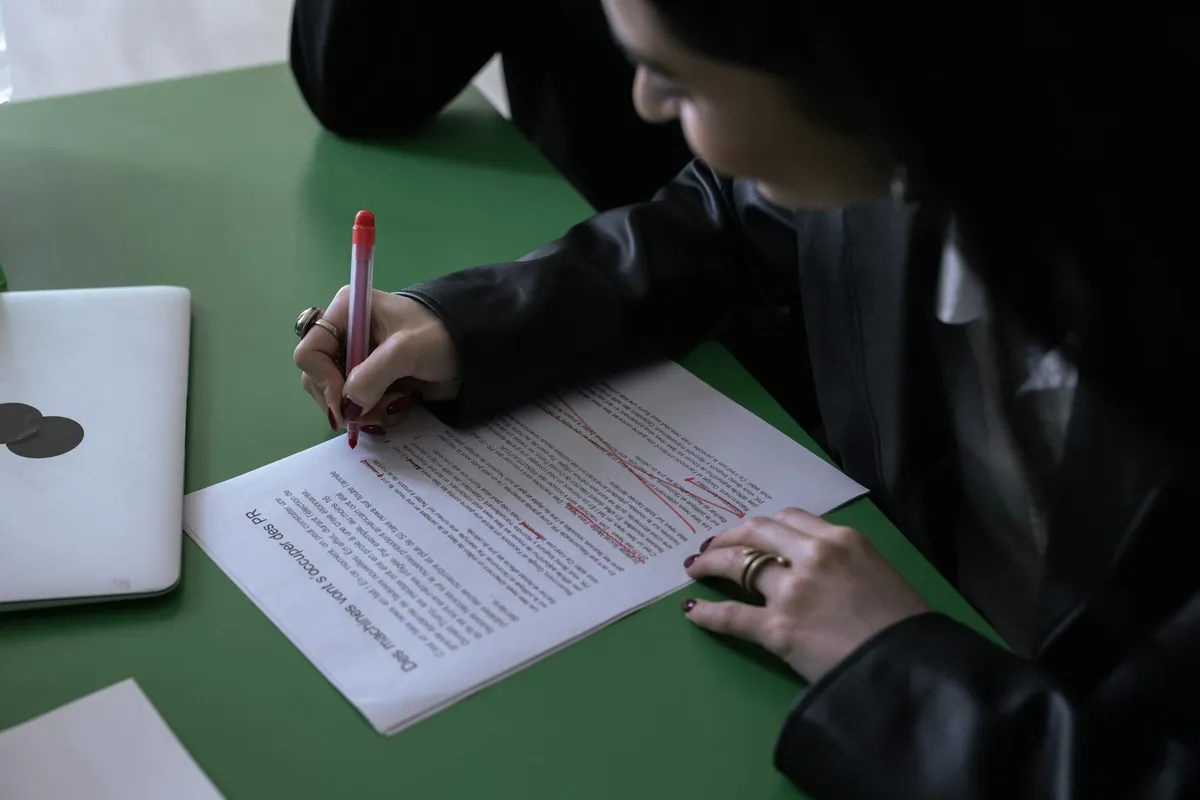
Read your draft aloud. From the printed page, not the screen. With a pen in your hand. This single practice catches more editing problems than any other technique I know — typos, awkward sentences, structural issues, hedging, length.
It feels slow. It's actually faster than the alternative, which is missing problems and fixing them in the next round.
The 3-pass schedule
If you have a chapter due in two weeks, here's the editing schedule that consistently works:
- Day 1-7: Write the first draft. Don't edit.
- Day 8: Sleep on it. Don't look at it.
- Day 9-10: Pass 1 (structure). Move things around. Cut entire sections if they don't serve.
- Day 11-12: Pass 2 (paragraphs). Read aloud. Tighten sentences.
- Day 13: Sleep on it.
- Day 14: Pass 3 (typos, formatting). Final read-through. Submit.
This three-pass approach, with the sleep gaps, produces measurably better drafts than continuous editing.
Try this on your next draft
Don't edit while you write. Finish the section. Sleep. Print it. Read it aloud with a pen.
The mistakes you catch will surprise you. The improvement will be larger than the time investment suggests.